China’s Shenzhou‑24 Launch Carries First Pakistani Astronaut to Tiangong Station
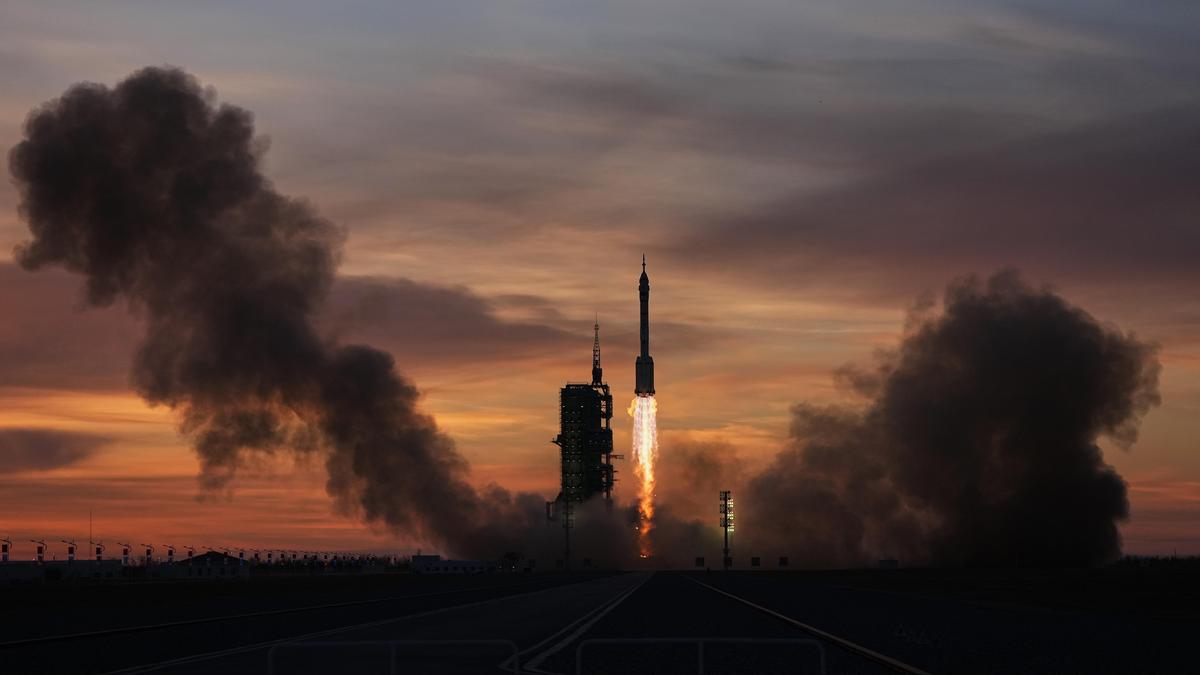
China launched the Shenzhou‑24 crewed mission on 25 Nov 2026, sending three astronauts – including Pakistan’s Muhammad Zeeshan Ali, the first foreign participant in China’s space programme – to the Tiangong space station for a week‑long stay.
Source: The Hindu
Key takeaways
- Shenzhou‑24 lifted off from Jiuquan on 25 Nov 2026 with three crew members.
- Pakistani astronaut Muhammad Zeeshan Ali is the first non‑Chinese on a Chinese crewed flight.
- The mission will dock with Tiangong, conduct over 90 experiments and return Ali after about a week.
- The flight follows a 2025 China‑Pakistan agreement and highlights growing bilateral space cooperation.
China launched the Shenzhou‑24 crewed spacecraft on 25 November 2026, marking the first time a foreign national has flown on a Chinese crewed mission. The launch, from the Jiuquan Satellite Launch Centre, carried three astronauts – mission commander Tang Hongbo, flight engineer Wu Yi and Pakistan’s Muhammad Zeeshan Ali – and is expected to dock with the Tiangong space station within hours.
Mission profile and objectives
Shenzhou‑24 rode atop a Long March‑2F carrier rocket and lifted off successfully, according to officials at the launch site. The primary goals of the flight include a crew rotation with the Shenzhou‑23 team, routine station upkeep, and a suite of scientific and technology experiments. Over 90 experiments are slated, covering space life sciences, materials science, micro‑gravity fluid physics, combustion science, fundamental physics, space medicine and new space technologies.
International cooperation
The presence of Muhammad Zeeshan Ali follows a bilateral agreement signed in February 2025 between China and Pakistan. Ali will spend roughly a week aboard Tiangong before returning to Earth on the Shenzhou‑23 spacecraft, a much shorter stay than the typical six‑month Chinese missions. Pakistani leaders hailed the flight as a source of national pride and a boost for the country’s youth, linking it to broader China‑Pakistan friendship and infrastructure projects.
Tiangong’s role in the global space landscape
China’s Tiangong station, operational since 2022, is currently the only independent space station in orbit after the United States plans to retire the International Space Station (ISS) by early 2031. Tiangong is smaller than the ISS, which has hosted multinational crews and over 3,000 experiments since 1998. China built its own station after being excluded from the ISS over concerns about the People’s Liberation Army’s involvement in its space programme.
What it means for students and parents
- Exposure to international space missions can inspire interest in STEM subjects among school‑age children.
- The collaboration showcases career pathways in aerospace engineering, robotics and space medicine.
- Short‑duration flights like Ali’s demonstrate that space research is becoming more accessible to a wider pool of nations.
- Ongoing experiments in micro‑gravity and materials science may lead to technologies that impact everyday life, from medical devices to advanced manufacturing.
The Shenzhou‑24 flight underscores China’s growing capability to conduct independent crewed missions while expanding its diplomatic reach through space cooperation. For Indian students and families, the mission highlights the importance of developing expertise in robotics, aerospace engineering and related fields to stay competitive in a rapidly evolving global space sector. As regional partners deepen ties with China’s space programme, opportunities for joint research, internships and academic exchanges are likely to increase, offering new avenues for Indian youth to engage with cutting‑edge technology.
The week‑long stay of a Pakistani astronaut aboard Tiangong also signals a shift toward more inclusive crew compositions, potentially paving the way for future multi‑national missions. For educators, the mission provides a concrete case study to discuss orbital mechanics, life‑support systems and the engineering challenges of docking spacecraft – topics that align with national curriculum standards in physics and technology.
Overall, the Shenzhou‑24 launch reflects a broader trend of expanding space participation beyond the traditional ISS partners. As more countries seek to develop their own capabilities, the demand for skilled professionals in robotics, avionics and space‑related research will rise, making early exposure and education in these areas increasingly critical for India’s next generation.
Source: The Hindu
Likes are stored anonymously in this browser.
Related stories
Robotics
CortexSpark Ventures launches ₹1,000 cr deep‑tech fund to back AI, robotics and more
Former Infosys leaders Vinay Peshwa and Sanjay Khanduri have raised a ₹1,000 cr (potential ₹1,400 cr) deep‑tech fund, targeting 20 Indian startups in sectors such as spacetech, defence, embodied AI, robotics, med‑tech and advanced materials.
Robotics
IITs to Add 6,000 Seats in Robotics, Physical‑AI and Space Technology from 2027
The Bhupat and Jyoti Mehta Family Foundation will fund 6,000 new undergraduate, postgraduate and doctoral seats across six IITs, focusing on robotics, physical AI and space engineering to build a talent pipeline for India’s emerging tech sectors.
Robotics
IIT Madras builds SEANAV digital twin to test autonomous ships safely
Researchers at IIT Madras developed SEANAV, a real-time digital twin to simulate ships and conditions for training and testing autonomous navigation.
Comments
Comments appear immediately. Profanity is blocked, and readers can report comments for moderator review.
Loading comments…